
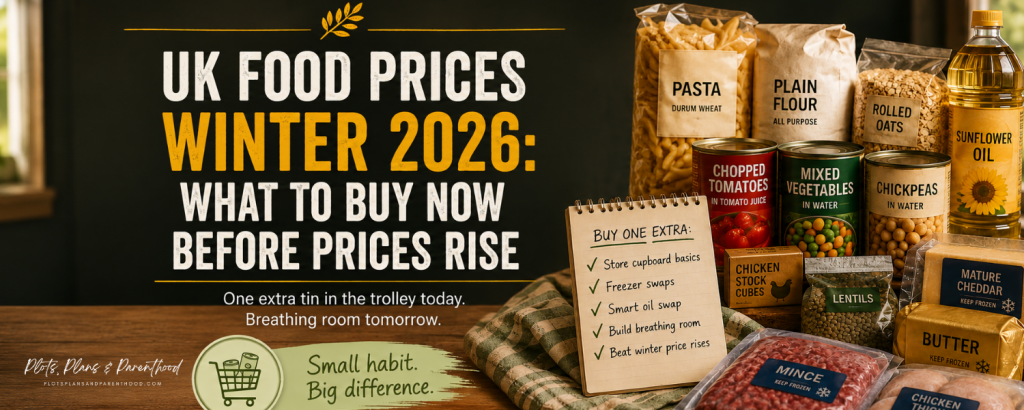
The Quiet Way to Get Ahead of Winter Food Prices
You don’t need a bunker. You need one extra tin in the trolley.
Food prices are heading up again over the next few months, driven by three things at once: the worst UK harvest since records began in 1984, Mediterranean wildfires wiping out olive groves and vegetable crops, and shipping disruption in the Middle East pushing up fertiliser and fuel costs. None of that is scaremongering, it’s what farming unions, retailers and government drought reports are already saying openly. The current view seems to be that we can expect another increase on food prices of 6% or more, and that’s the conservative side of things.
The good news is you don’t need to panic buy or clear a shelf. You need to adopt a small, boring habit: when you do your normal shop, pick up one extra of something that keeps. Do that for a few months and by December you’ve quietly built yourself some breathing room, without ever having a “big shop” that blows the budget.
Here’s what’s worth an extra pack, and why.

Foods Worth Buying Before Prices Rise
Flour, pasta, oats, rice.
Wheat had the worst UK harvest on record this year, and Europe’s isn’t much better.
Bread and anything wheat-based is the item most likely to jump first, because there’s simply less of it. Dried pasta and rice keep for well over a year, so there’s no downside to having a spare bag in. Bread is more of a challenge, it does freeze, if you have room, but if space is an issue, grab flour instead and you’ll have the means to make everything from pancakes to artisanal bread, the only limit is your imagination and your baking skills.
Tip:
With flour and oats, freeze the sealed packs for 4 days before storing (inside a Ziploc bag works best), this kills any weevils, grain beetles, and meal moths, and stops spoilage. Leave out of the freezer, (and out of the Ziploc bag) on the bench for 48 hours before storing away. This allows it to return completely to room temperature and prevents condensation from making the flour or oats damp. Alternatively, flour and oats can be store permanently in the freezer, if you have space.
Sunflower or vegetable oil.
Olive oil is already expensive and set to rise further after wildfire damage to Mediterranean groves. Sunflower oil production is also down on last year, but a bottle of either keeps for months unopened. If you use oil often, one extra bottle now is a pretty straightforward saving later on when prices will rise.
Tinned tomatoes, tinned vegetables, frozen veg.
Fresh onions, carrots, garlic and leeks are the vegetables most affected right now, because growers in the UK and France are short of water for irrigation. Tinned and frozen versions are grown and processed earlier in the season, so they’re less exposed to this particular squeeze, and they’re a straight swap in most recipes. Frozen veg is quick and easy, check out Farmfoods for really good deals, Iceland is also worth a look.
Tinned tomatoes are the basis for a lot of dishes and in reality there is not a huge difference in quality between the cheapest supermarket generic brands, and the expensive ones. Whole peeled canned tomatoes will always be of slightly higher quality than the crushed ones.
Stock cubes and tinned pulses.
Cheap, filling, keep indefinitely, and useful if meat prices climb (see below). Lentils can be added to curries, bolognese, chilli, soups and stews to bulk them out, and add some protein.
Freezer swaps worth making now
Butter and hard cheese.
Both butter and cheese freeze really well. Dairy farmers are already feeding animals winter fodder in August because there isn’t enough grass, which is an early and expensive sign for milk, butter, cream and cheese prices. If you spot a decent offer, a block of butter or a bag of grated cheese in the freezer is money in the bank. Farmfoods 10 for £10 butter deal has had social media foodies raving, so it’s worth a look. Be aware that grated cheese often has starch added to keep it separated, and it can go mushy after defrosting, so it might be worth investing in block cheese to freeze, and grate it yourself – blocks are also easier to store.
Meat, if you have any freezer space at all.
Feed costs are rising for the same reason grass is in short supply, and that tends to work through to meat prices with a lag. You don’t need a chest freezer. Even an extra pack of mince or chicken thighs when they’re on offer is worth it. Check out Iceland and Farmfoods for frozen mince deals. Also, off school holidays, Deliveroo runs ‘Fridge Filler Monday’s’ and it’s worth a look to see if there are meat deals to be had, they’re often 50% off the normal price.

one swap to make permanently, not just for now
If olive oil is your usual, it’s worth getting used to cooking with sunflower or rapeseed oil for everyday frying and roasting, and saving olive oil for where it actually matters, like dressings. That’s not a hardship swap, it’s just sensible, and it takes the pressure off the ingredient that’s rising fastest.
What this Is…and What it isn’t.
None of this is about a 2020’s pandemic style clearing of the supermarket shelves.
Nor is it about panic buying or clearing out the spare room and stockpiling like the four horsemen are on their way.
It’s about buying a little extra of things you regularly use, that the evidence says prices will rise on, over the next few months.
Perishables like fresh fruit and veg, bread, and fresh milk don’t belong on this list, buy those as you normally would. Although, you can freeze milk if you have the space.
The idea is simply this: for the next couple of months, when something on this list is at a normal price or on sale, buy two instead of one. By the time Winter costs land, you’ll have quietly taken some of the sting out without ever having felt the pinch of a big shop.
Have you started thinking about planning for the Autumn/Winter food price hike?
What things will you be stocking up on over the next few months to get you through the Winter comfortable.
‘Winter 2026 – Pantry Staples Guide’, coming soon.
Planning ahead for Autumn/Winter? Check out the
Five Herbal Teas You Will Need This Autumn